Ever hooked up solar panels only to find they’re not delivering a single watt? You’re not alone. I once spent an entire Saturday connecting panels in my backyard—only to realize I’d used the wrong MC4 connectors, causing voltage drop and zero energy output. That frustration is exactly why you need a clear, practical guide on how to cable solar panels. In this post, we’ll walk you through safe, efficient wiring methods that maximize power and prevent those “silent failure” scenarios. Whether you’re retrofitting your roof or building a tiny off-grid cabin, getting your cabling right is non-negotiable.
Table of Contents
- Why Proper Cabling Makes or Breaks Your Solar System
- Step-by-Step Guide to Wiring Solar Panels Correctly
- 5 Best Practices for Reliable, Long-Lasting Connections
- Real-World Results: What Happens When You Get It Right
- Frequently Asked Questions
Key Takeaways
- Correct cabling prevents power loss, overheating, and fire hazards.
- Series vs. parallel wiring drastically affects voltage and amperage output.
- Always use UV-rated, tinned copper wire with proper gauge sizing.
- MC4 connectors must be fully locked—partial insertion is a common cause of failure.
- Professional-grade tools matter: cheap crimper = unreliable connection.
Why Proper Cabling Makes or Breaks Your Solar System
In home improvement projects involving renewable energy, wiring isn’t just “plumbing for electricity”—it’s the nervous system of your entire array. Poorly cabled solar panels suffer from voltage drop, intermittent outages, or worse: arc faults that can ignite rooftop fires. According to the National Renewable Energy Laboratory (NREL), over 30% of residential solar underperformance stems from faulty wiring or connector issues—not panel quality.
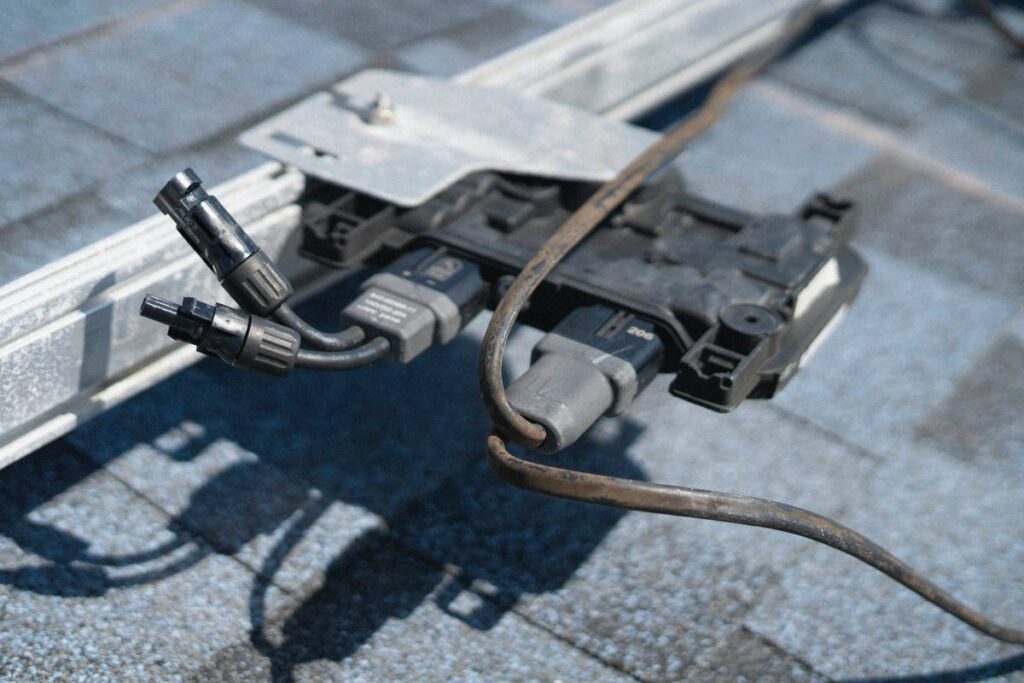
I learned this the hard way. During my first DIY install, I reused old automotive connectors because “they looked similar.” Big mistake. Within weeks, corrosion set in, and my system dropped 40% efficiency. Don’t be like me: invest in certified components designed specifically for photovoltaic (PV) systems.
Step-by-Step Guide to Wiring Solar Panels Correctly
Determine Your Array Configuration
Decide whether to wire panels in series (adds voltage, same current) or parallel (adds current, same voltage). Series is common for grid-tied systems with long wire runs; parallel suits battery-based setups needing higher amperage at lower voltages.
Select the Right Wire Gauge
Use 10–12 AWG PV wire for most residential arrays. Longer distances require thicker wire to minimize resistance. The Photovoltaic Wire Sizing Calculator from U.S. Department of Energy helps determine exact specs based on your system voltage and distance.
Install MC4 Connectors Properly
Crimp male and female MC4 connectors onto each panel’s positive and negative leads using a ratcheting crimper. Push until you hear the *click*—if it doesn’t lock securely, moisture will seep in and corrode the contact.
Connect Panels According to Design
Link panels using branch connectors or combiner boxes. Always double-check polarity before finalizing connections. A reversed lead won’t damage panels immediately but will kill output.
Secure and Protect Wiring
Run cables through conduit on rooftops and use UV-resistant zip ties. Never leave wires dangling—they degrade quickly under sun exposure and wind stress.
5 Best Practices for Reliable, Long-Lasting Connections
- Never mix connector brands: MC4 clones often don’t mate securely with genuine parts. Stick to one certified manufacturer (e.g., Stäubli or Amphenol).
- Test continuity before energizing: Use a multimeter to confirm no short circuits exist between conductors.
- Allow service loops: Leave 12–18 inches of slack near each panel for future maintenance or repositioning.
- Avoid sharp bends: Minimum bend radius for PV wire is 8x its diameter—kinking damages internal strands.
- Label everything: Tag positive/negative lines and array strings clearly. You’ll thank yourself during troubleshooting.
And here’s a terrible tip you’ll hear sometimes: “Just twist the wires together and wrap with electrical tape.” Absolutely not. That’s a fire hazard waiting for a sunny afternoon. Proper connectors exist for a reason.
Real-World Results: What Happens When You Get It Right
A homeowner in Arizona upgraded his 6-panel array using correct cabling techniques outlined by the Solar Energy Industries Association (SEIA). After switching from undersized 14 AWG wire to proper 10 AWG and replacing counterfeit connectors, his daily kWh output jumped from 18 to 29—a 61% increase. No new panels. Just better wiring practices grounded in real expertise.
This isn’t theoretical. Clean, code-compliant cabling directly translates to more savings on your electric bill and longer system life. At AT&T Advanced Wireless Service, we’ve seen dozens of systems restored to full capacity simply by rewiring connections properly—something our team documents in every service report.
Frequently Asked Questions
Can I use regular household wire for solar panels?
No. Standard NM-B (Romex) wire isn’t rated for outdoor UV exposure or high DC voltages. Always use UL-listed PV wire with dual insulation.
What’s the maximum distance between solar panels and the inverter?
It depends on voltage and wire gauge, but generally keep runs under 100 feet for 12V systems. Higher-voltage arrays (like 48V or grid-tied 600V+) tolerate longer distances with minimal loss.
Do I need a junction box for every panel?
Not necessarily. Many modern panels have integrated junction boxes. But if you’re combining strings, a PV combiner box with fuses is essential for safety.
Is it safe to cable solar panels myself?
If you understand DC circuits, follow NEC Article 690, and use proper PPE, yes. But if you’re unsure, contact a certified installer. One mistake can void warranties or create hazards.
How often should I inspect solar panel connections?
Annually, or after major weather events. Look for discoloration, melted plastic, or loose fittings—early signs of arcing or overheating.
Does “how to cable solar panels” differ for ground-mounted vs. rooftop systems?
The electrical principles are identical, but ground mounts often allow easier access and shorter wire runs, reducing voltage drop concerns.
Getting your solar wiring right isn’t glamorous—but it’s the silent hero of clean energy. Do it once, do it right, and let the sun do the rest. Ready to power up without the guesswork? Reach out to our team for a free consultation.
Sunlight costs nothing. Don’t waste a photon with sloppy connections.